PVC Pipe Toy Hanger (and a note about CVI)

When our first vision therapist came to us from the wonderful Visually Impaired Preschool Services of Indianapolis, she brought with her this amazing DIY hanging rack so Ryan could sit or lay under it and look at the objects. And one day he finally started reaching for the things! Anyone can make this cheaply out of PVC pipe. Ours is 1/2″ diameter and 24″ long on top and 26″ long on each side. We added the foam around the edges for when he would fall over onto the frame, though now he sits in a chair in front of the frame.

We switch out the toys as he gets sick of them but consistent favorites have always been a water bottle filled with popcorn and covered with the green mop slippers and the bell braceletJar lid rings are also a hit given their shininess and auditory feedback and Ryan really loves to grab the gold cat toy as well. Slinkies are also a great thing to hang. We’ve added more items as his vision has grown stronger.
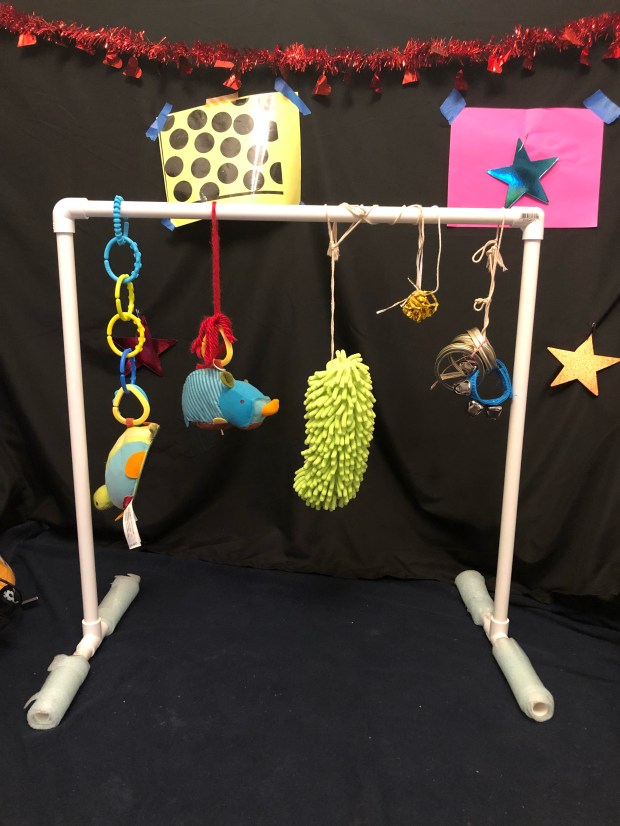
PVC toy frame

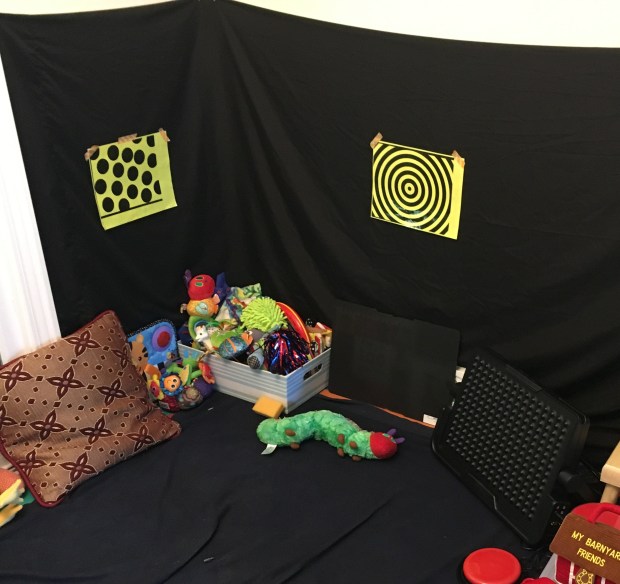
Hanging Toy Frame (against Ryan’s play corner with black sheet/garland, etc)
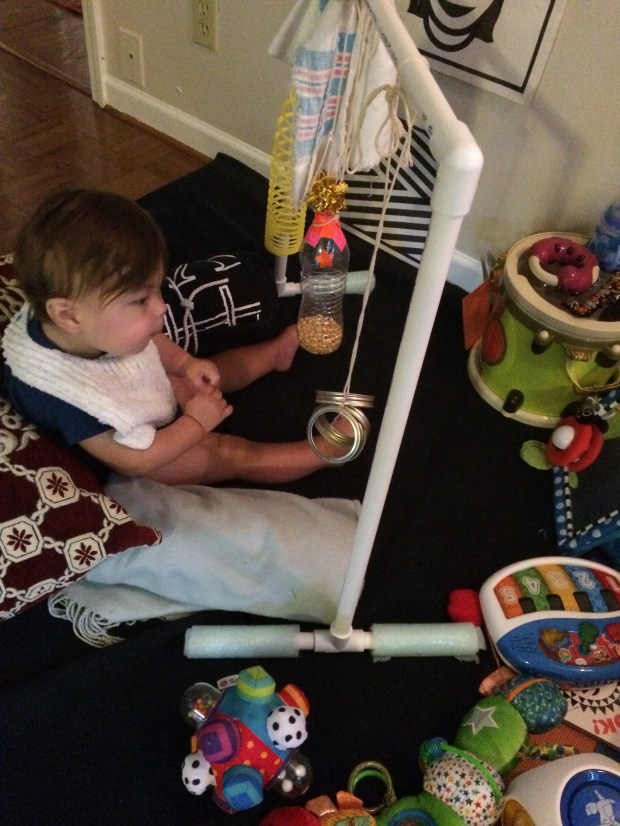
IMG_4932

When Ryan first received this, he would sit and look at the toys. Then eventually he started reaching for them. Now he plays with them voraciously.

Once Ryan got a little bigger, we got this little chair for him to sit in and reach forward to play with his hanging toys. We put shelf liner on the bottom of it so he doesn’t scoot down and slip out of the chair, and we tie a swaddle blanket around his waist and the chair as a seat belt of sorts to keep him there safely.
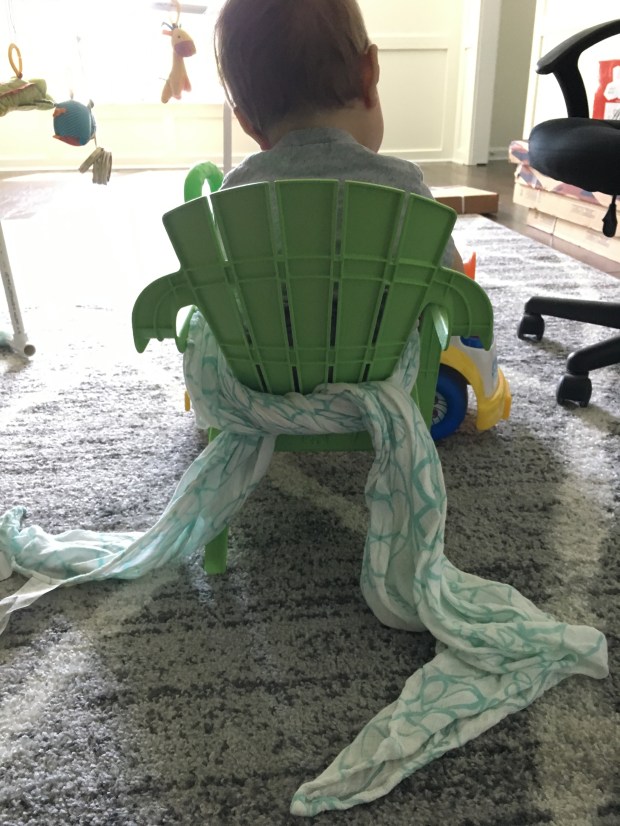
IMG_0428

You may also notice the black sheet up in Ryan’s play area, and the black blanket on the ground, plus the high contract patterns and shiny garland. We try to cut down on the visual clutter as much as possible to help his brain focus as well as give him strong points of interest to focus on (garland/shiny stars, etc; Party City is the best for this stuff). Looking at objects against a black background is also thought to be helpful, hence the blanket. Cutting down visual clutter is incredibly important for kids with Cortical Visual Impairment which affects many kids with ATR-X. If you think your kiddo might have CVI, I’ve found these sites to be helpful for tips on improving Ryan’s ability to focus visually:


img_2194

The box of toys has been moved and other toys are hidden behind the sheet now to make his play area as de-cluttered as possible.
Adapting Books and Puzzles for CVI

There are lots of great suggestions online for adapting things in your home for your child with cortical visual impairment or CVI, to help the brain better be able to focus on an object or environment. Here are some of my favorite ideas, both involving a Sharpie:

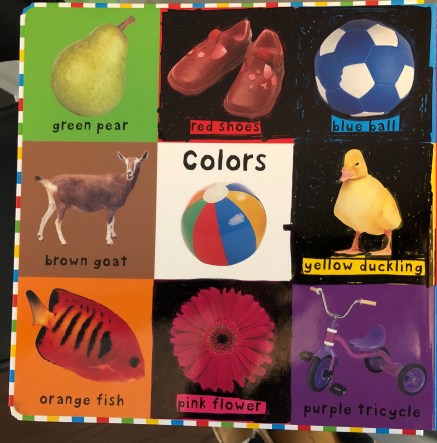
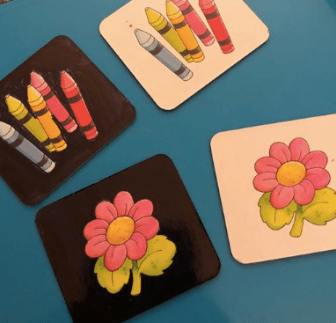
1. Black out the background on busy pages in books to reduce the complexity of what your child is looking at and help your child “see” the main objects on these pages. I’ve had luck with some books but not with others that have super shiny/slick pages as the market doesn’t stick.

See how hard the purple bicycle or green pear are to see below, when against their like-colored backgrounds? That’s tough for a kid with CVI. The slick finish of these pages wasn’t the best for my Sharpie but would be easy to cover with black construction or contact paper, if you’re somewhat crafty (which, to be honest, I am not).

Colors

Here’s another example from another CVI mom:

screen shot 2019-01-28 at 9.39.03 am

2. Trace the objects on the pages so they have a black frame around them, which will help your child “see” them. (I also think many of these Jellycat books are great for CVI kids, given the simplicity of the pages).

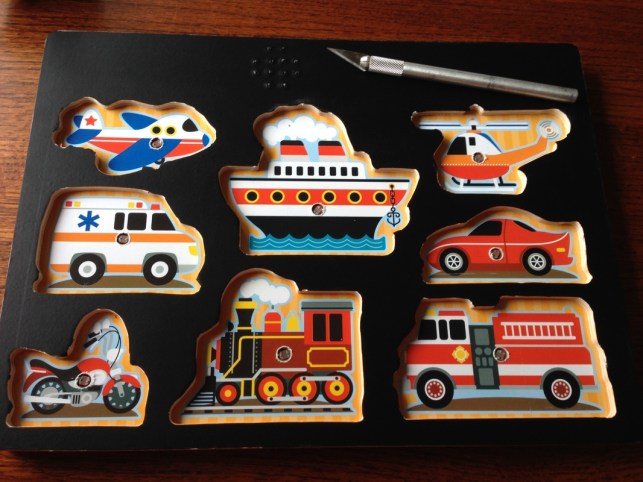
3. Black out the background on wooden puzzles to help your child “see”the pieces to grab. You can use a Sharpie if the material allows or get fancy and use black shelf paper and an exacto knife, as shown in this blog post from Making Our Way In a Typical World.

black out puzzle
                                                                                                                             Picture from Making Our Way in a Typical World

4. Color in the pages with the colors that interest your child. Black & White books are great, and are the first books that ever grabbed my kiddo’s attention. Take colored Sharpies and color in the white parts of these pages with the color that appeals most to your child.

Coloring books

Find more great ideas for your kid via the CVI Awareness Facebook group.

Necessary Objects = Shelf Liner

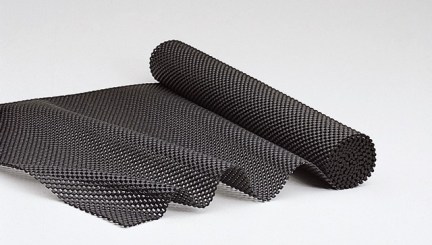
We have so much shelf liner in our house. It makes any seating area a sticky surface to help Ryan stay seated in place rather than slip and slide around in a chair due to his hypotonia. We used it more when he was smaller and had lower muscle tone/hypotonia and it was so helpful. We still keep a piece in our diaper bag so we can put it down on any high chair when we’re out in public, which helps keep him seated in place. Highly recommend this trick.

IMG_1496 (1)

Our trusty piece of shelf liner that goes everywhere we do, cut to fit most restaurant high chair seats.

You can also put shelf liner under toys to help them stay in place while your child is playing with them, or under dishes on their high chair tray to help them stay put.

Black liner can also simply be used to provide a visually high contrast background to a toy or food plate.

shelf liner

ATR-X INFO & RESEARCH

What is ATR-X? The ATRX gene is essential to brain function and may play a role in regulating the activity of other genes, so any alteration to this gene (as happens with ATR-X the disorder) causes a domino effect of issues affecting the entire body.  ATR-X the disorder can be inherited (carried by/passed on by the mother; it typically does not express in or affect females) or a de novo (spontaneous at conception) mutation on the ATRX gene. It is important to know is that ATR-X is a spectrum disorder which means the severity can range from mild to profound. It almost always affects boys but very rarely also affects girls as well. I’ll refer to boys most often on this site to keep things simple.

Every. Single. Boy. is different and will do things on their own timeline. There’s no way to know how your kiddo will develop. So never underestimate them. And keep in mind at the base of it all is what your job as a parent is: make them feel loved and safe and do your best to keep them healthy. That’s all you have to do. Don’t worry about anything else. Are they happy as they can be? Then you’re doing a great job.

ATR-X affects EVERYTHING.

A quick overview of how ATR-X affects individuals:

  • Intellectual disability is very common and can be on the more severe side, unfortunately. Cortical Visual Impairment is related and a common issue as the brain often cannot process vision correctly.
  • Verbal communication: While some boys learn to talk, it’s quite common for boys to be nonverbal or have very limited words. Sometimes they are able to use communication devices and technology is providing better and better communication options every day.
  • Physical disability: Almost all boys are somewhat to very delayed on their physical milestones. Marked hypotonia (low muscle) is typical for all ATR-X boys. Some boys learn to walk (by age 3 or 5 or 8…) but many boys use wheelchairs or need help to be mobile indefinitely. Fine motor skills can be difficult–reaching for and picking up items are skills that may be learned with time. Sitting up can take a while (our kiddo mastered this at age 3.5….we were so proud!).
  • Physical appearance: ATR-X boys can often look somewhat similar and there’s reason to believe that the ATRX gene plays a role in facial formation. Many of the boys have upturned mouths, widely spaced teeth, low nose bridges, etc. What they all have in common? They’re ADORABLE, with amazing smiles and laughs and often really great hair.
  • Breathing difficulties:  Respiratory problems are common. Central and/or obstructive apnea is widespread and some of our boys are trached (have a tracheostomy tube) or on oxygen at various times. Anesthesia can hard on the boys and they are often kept in the hospital after surgeries for longer than anticipated due to low oxygen levels. Keep an eye on any respiratory infections that can lead to pneumonia as this can be a cause of mortality in ATR-X boys (and read up on the signs of sepsis as well).
  • GI issues: Many boys have GI issues of some form (chronic constipation, severe reflux, malrotation of the intestines, rumination, EOE), often causing severe pain. Unfortunately this is a BIG mystery area that leaves doctors puzzled on how to cure the pain. Most boys are on a laxative or probiotic of some form to stay regular.
  • Genital abnormalities: Many boys have undescended testicles, microgenitalia or other genital abnormalities.
  • Seizures: Roughly 30% of our boys deal with seizure activity, according to the Dutch ATR-X Foundation.
  • Skeletal abnormalities: From scoliosis & kyphosis (curvature/rounding of the spine) to brachydactyly (shortening of the fingers and toes due to unusually short bones) to hip issues (coxa valga/coxa vara) and more, many boys deal with skeletal issues. Additionally, many boys are of short stature.

The Dutch ATR-X site lists the most common major issues by bodily system here.


Read more about ATR-X on these sites:

Our Dutch friends have particularly strong resources for ATR-X:

ATR-X Research

Research on ATR-X is very limited due to the rarity of cases but there have been some hopeful developments by researchers recently, in particular due to the creation and involvement of the ATR-X Research Alliance group and Simon’s Searchlight.
Follow the ATRX Research Alliance on Facebook to stay up to date on their efforts. Their most recent video update is recorded here (October 2024) and they share some amazing research developments and you can also get introduced to some of the main researchers leading the charge.

ATRX Research Alliance works together with Simon’s Searchlight to further ATR-X research. Sign up and share your family’s genetic report so researchers have a better understanding of our community’s numbers and give them access to all information. Many researchers still think ATR-X affects so few people that it’s not worth researching. We know our numbers are bigger than believed so signing up and sharing your paperwork will help prove that ATR-X is worth studying. Sending in a blood sample is voluntary but is a huge contribution to the study of this condition. Please consider being a part of the research.

Additionally, in 2018 at Tohoku University in Japan. These show that the intellectual disability in mice with ATR-X was improved in two different trials, one in which the mice were given a compound called 5-ALA and another in which they were given a substance called SA4503. Two important notes here are that the cognitive function was improved in mice already afflicted with ATR-X (so it could potentially help boys already diagnosed) and that the trial was done in mice. Human trials are likely a long ways off and approved treatments are even further away. But still…there is hope!


Groups to follow for more information:

Am I missing any? Please share! email Allaboutatrx@gmail.com

frog4

Please note I am not a medical professional nor do I give medical advice on this site; I just aim to share as much information about ATR-X as possible and collect it all in one place.
Speak to your doctor before making any medical decisions.

STAYING STRONG

This syndrome is TOUGH. When you’re first diagnosed, get help. Build your community and army of support. It took 11 long months from the day we were diagnosed for me not to cry daily and be able to speak about it without being overwhelmed by emotion. But. Somehow you come to the realization that while this is still completely heartbreaking and awful and not the life you had planned, it’s the life you have so you might as well make the best of it. As Sheryl Sandberg would say, there is no option B. It forces you to get to the most basic understanding of being a parent and that is to raise a child who feels loved and happy and safe. And nothing else. Nothing else matters. So you do your best. And maybe have an extra glass of wine at night. Because you deserve it.

And this poem helps (no offense to the Dutch):

Welcome To Holland

(c)1987 by Emily Perl Kingsley. All rights reserved

I am often asked to describe the experience of raising a child with a disability – to try to help people who have not shared that unique experience to understand it, to imagine how it would feel. It’s like this……

When you’re going to have a baby, it’s like planning a fabulous vacation trip – to Italy. You buy a bunch of guide books and make your wonderful plans. The Coliseum. The Michelangelo David. The gondolas in Venice. You may learn some handy phrases in Italian. It’s all very exciting.

After months of eager anticipation, the day finally arrives. You pack your bags and off you go. Several hours later, the plane lands. The stewardess comes in and says, “Welcome to Holland.”

“Holland?!?” you say. “What do you mean Holland?? I signed up for Italy! I’m supposed to be in Italy. All my life I’ve dreamed of going to Italy.”

But there’s been a change in the flight plan. They’ve landed in Holland and there you must stay.

The important thing is that they haven’t taken you to a horrible, disgusting, filthy place, full of pestilence, famine and disease. It’s just a different place.

So you must go out and buy new guide books. And you must learn a whole new language. And you will meet a whole new group of people you would never have met.

It’s just a different place. It’s slower-paced than Italy, less flashy than Italy. But after you’ve been there for a while and you catch your breath, you look around…. and you begin to notice that Holland has windmills….and Holland has tulips. Holland even has Rembrandts.

But everyone you know is busy coming and going from Italy… and they’re all bragging about what a wonderful time they had there. And for the rest of your life, you will say “Yes, that’s where I was supposed to go. That’s what I had planned.”

And the pain of that will never, ever, ever, ever go away… because the loss of that dream is a very very significant loss.

But… if you spend your life mourning the fact that you didn’t get to Italy, you may never be free to enjoy the very special, the very lovely things … about Holland.